Pentatrutide: a penta (five-receptor) multi-agonist peptide — the flagship of Panacea's range
One engineered chain, five coordinated metabolic arms. Pentatrutide is the top of Panacea Bio Chem's multi-agonist Peptourbillon range — reaching past the triple-agonist era for a broader, better-composed result.
A Panacea Bio Chem product monograph · by Bogdan Dicoias, Inventor & amino-acid-chain designer
· Subject: penta / five-receptor multi-agonist peptides ·
Programme: Pentatrutide (Panacea) · Nothing here is medical advice.
Development status
All of these peptides were synthesized, tested in vivo and in vitro, and are undergoing clinical trials as we speak — although many further details remain secret.
Multi-agonist design is patient peptide engineering — many receptor arms tuned to work as one. This is the discipline behind Pentatrutide, the flagship five-receptor Peptourbillon by Panacea Bio Chem, developed by Bogdan Dicoias.
Abstract
Pentatrutide is a penta (five-receptor) multi-agonist peptide — a single engineered
chain designed to engage five complementary metabolic receptor arms at once. It is the flagship
of Panacea Bio Chem's multi-agonist Peptourbillon™ range: built on the triple-agonist
(GLP-1 / GIP / glucagon) template that defines today's strongest metabolic peptides, then extended
with two further arms so their effects combine and their weaknesses offset. This monograph explains multi-agonism from the ground up — the climb from mono to dual to triple to penta — then presents Pentatrutide as a next-generation entry engineered for the range's hallmark:
more muscle spared at a matched degree of weight loss and a far gentler side-effect
profile than the reference agents. It is delivered as a multi-layer cake in a dual-chamber
Lyoprester® cartridge and an EZnject™ pen. This is a scientific description of a class
and a formulation, not medical advice.
Molecule: Pentatrutide (penta multi-agonist) |
Class: five-receptor multi-agonist peptide |
Range: Panacea Bio Chem Peptourbillon multi-agonist range (flagship)
Product identity · Pentatrutide Peptourbillon™
Working name
Pentatrutide — flagship of the Panacea multi-agonist range
Class
Penta / five-receptor multi-agonist peptide
Formulation
Multi-layer Peptourbillon™ — a Panacea-engineered multi-agonist peptide blend
Delivery
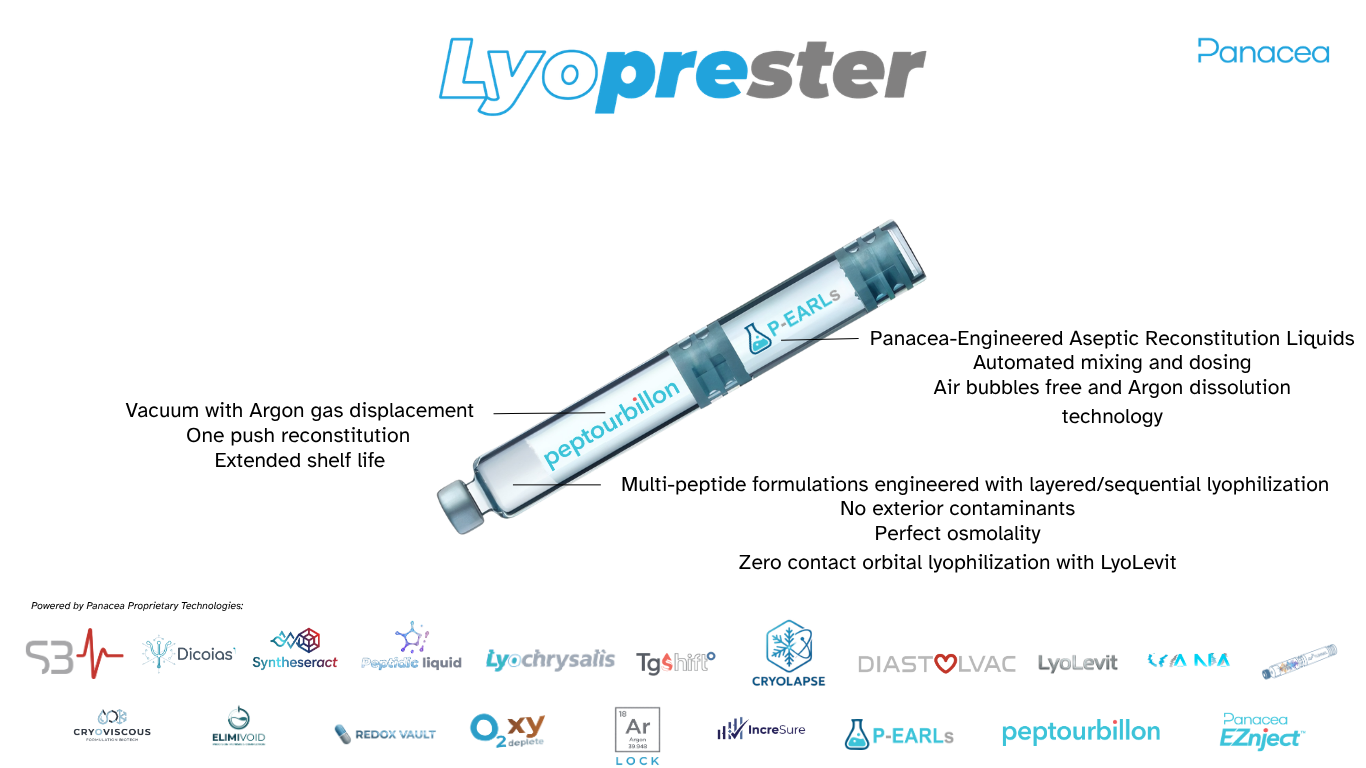
Dual-chamber Lyoprester® cartridge (lyophilised cake + matched P-EARLs™ diluent), dispensed by an EZnject™ pen
Hallmark
Designed for less lean-mass loss and a gentler side-effect profile than counterpart agents
Availability
A Panacea Bio Chem research programme — explore the multi-agonist range at the hub
1. What a multi-agonist peptide is — and how the field reached penta
Metabolic medicine spent a decade learning a single lesson: one receptor is rarely enough.
The body's control of appetite, blood sugar and fuel-burning is shared across several gut-and-pancreas
hormones, each pressing its own receptor. A multi-agonist peptide is one engineered chain built
to press more than one of those receptors at the same time — so a single molecule can do the work of a
small committee of hormones. The story of the field is simply the story of adding arms:
Mono-agonist. One receptor. Semaglutide-class GLP-1 agonists → press the GLP-1 receptor to lift insulin when glucose is high, slow the stomach and curb appetite.
Dual-agonist. Two receptors. Tirzepatide adds the GIP arm to GLP-1, sharpening insulin sensitivity and appetite control together.
Triple-agonist. Three receptors. Retatrutide welds a glucagon arm onto GLP-1 + GIP, so the molecule also raises energy expenditure and burns hepatic fat — the class behind the strongest weight-reduction data reported to date.1
Penta-agonist. Five receptors. The next rung: keep the triple base and add two further complementary arms, so more of the body's own metabolic levers move in concert. This is where Pentatrutide is aimed.
The intuition is simple: each arm covers a different part of metabolism, and — tuned correctly —
each can also offset the weakness of another. The glucagon arm burns fuel but nudges glucose
upward; the incretin arms (GLP-1, GIP) release insulin in a glucose-dependent way and pull that glucose
back down. Add an amylin arm and satiety deepens while gastric emptying is smoothed; add a
PYY / Y2 arm and the appetite signal is reinforced through a second, independent pathway. Five
arms, chosen so the pluses stack and the minuses cancel.
The frontier was never "how many receptors" — it is how finely you can balance them.
2. The five arms — one chain, five levers
Pentatrutide is engineered to address five metabolic receptor arms. The table below sets out the
arms and the job each one does; the exact relative potencies at which they are tuned are proprietary and
held with the programme.
The five receptor arms of a penta multi-agonist — contribution, the closest published precedent for each arm, and how far that precedent has been taken (arm-by-arm evidence stage assembled by Panacea Bio Chem, 5 September 2026)
Arm
Receptor
What it contributes
Closest published precedent
Stage of that precedent
GLP-1
GLP-1 receptor (class-B GPCR)
Glucose-dependent insulin, slowed gastric emptying, central satiety
Semaglutide, and every agent above it on the ladder7
Approved medicines
GIP
GIP receptor
Insulin sensitisation and appetite support; tempers nausea from the GLP-1 arm
Raises energy expenditure and hepatic fat oxidation; balanced against the incretin arms
Retatrutide — GLP-1 + GIP + glucagon in one chain1
Phase 2 published; phase 3 completed, results not yet posted
Amylin
Amylin / calcitonin-receptor complex
Deepens meal satiety and smooths post-meal glucose alongside the incretin arms
CagriSema — cagrilintide plus semaglutide: two molecules, not one chain4
Phase 3 published (a combination, not a chimera)
PYY / Y2
Neuropeptide Y2 receptor
A second, independent satiety pathway that reinforces reduced intake
GEP44 — a chimeric peptide at the GLP-1 receptor plus neuropeptide Y1 and Y2 receptors5
Preclinical (rodent)
Read the last two columns together and the design reads honestly. Three of the five arms
have already been welded into a single chain and taken into humans; the amylin arm stands on evidence
from a combination of two molecules rather than from one chimera; and a Y-receptor arm has been
built into a chimeric peptide in animals and not beyond. That is the real frontier a five-arm design
works at — and no other source we found sets it out arm by arm.
None of these arms is new to biology — each is a natural signal the body already uses. What is new
is welding all five into one durable, manufacturable chain whose arms are tuned to a deliberate
balance. That tuning — the relative pull of each arm — is the whole art, and it is the part Panacea
holds as a proprietary secret.
3. Why it matters — the open frontier of balance
Adding arms is easy to say and hard to do. Every receptor added widens what a molecule can achieve
and widens what can go wrong. Three tensions define the frontier that Pentatrutide is built against:
Relative-potency tuning. Five arms means five dials. Set the glucagon arm too strong and glucose drifts up; set the incretin arms too strong and tolerability suffers in the early weeks. The value of a penta-agonist lives entirely in getting that balance right — not in the count of receptors.
The quality of weight lost. Rapid, appetite-led weight loss on any agent of this kind tends to shed lean tissue alongside fat. The field's most important open question is not how much weight comes off, but what comes off. More arms, balanced well, is a route to protecting muscle while still moving fat.
Making and keeping the molecule. A five-arm chain is longer, more acylated and more fragile than a mono-agonist. Synthesising it purely, and keeping it intact from synthesiser to syringe, is where much of the real difficulty now sits — which is exactly where Panacea's preservation science meets the peptide (see §5).
These remain investigational questions, with genuine open debate over long-term effects, muscle
preservation, dosing and durability. Pentatrutide is offered here as a direction of design, not as an
outcome.
How far has the frontier actually got? — a dated, reproducible search
In our dated search of ClinicalTrials.gov and the scientific literature on 5 September 2026,
we identified no clinically registered or published unimolecular agonist targeting more than three
distinct receptor systems. That is a statement about what a defined search found on a defined day
— not a claim that nothing above three exists anywhere. Here is the method, so that anyone can
repeat it and correct us.
The frontier search, stated so it can be reproduced
Element
What we did
Search date
5 September 2026.
Databases
ClinicalTrials.gov API v2 (registry records) and a general literature lane over PubMed-indexed and open-web scientific sources.
Search strategy
Two lanes, deliberately. A hypothesis-driven lane searching the arms we expected to find (amylin, PYY, FGF21 added to an incretin base), and a property-first lane that presumes nothing about which receptors a molecule targets: quadruple agonist, quad agonist, tetra-agonist, four receptor agonist, quintuple agonist, penta agonist, multi-receptor agonist, polyagonist — plus receptor-combination strings discovered from whatever each lane returned.
What counted as “unimolecular”
One covalently continuous molecular entity. A co-formulation or fixed-dose combination of two molecules does not qualify, however well it works.
What counted as a distinct receptor target
A separate receptor gene product with a described agonist action. Two subtypes of the same receptor count once.
Included
Registered clinical trials at any phase, and preclinical molecules where a chimeric construct was published.
NOT searched
USPTO and EPO patent claim text; the EU CTIS register; ISRCTN; the China CDE register; non-English-language literature; unpublished corporate pipelines. A molecule can be real and sit entirely inside one of those universes.
Highest-order examples the search returned
Three receptors, one chain, in humans: retatrutide (GLP-1 / GIP / glucagon), phase 2 published.1A four-receptor challenger:NA-931, a clinically registered candidate whose sponsor describes an IGF-1 / GLP-1 / GIP / glucagon pharmacology. It is an external asset of Biomed Industries, not a Panacea programme, and it directly challenges this finding; whether it qualifies as unimolecular under the definition above is unresolved, because first-party sources conflict on its molecular class and no structure has been disclosed. We publish it rather than hide it. Beyond three by combination rather than by one chain: CagriSema, two molecules, phase 3 published.4A fourth receptor family built into a chimera at all: GEP44, rodent only.5
Update rule
If a qualifying molecule is identified, this section changes rather than becoming wrong. That is the whole point of publishing the method beside the result.
A note on the arms race. The multi-agonist idea grew from an accident of biochemistry.
Glucagon — the hormone now welded into every triple-agonist as its fuel-burning arm — was first met a
century ago as a contaminant: a hyperglycaemic impurity that spoiled early insulin extracts.
For decades its glucose-raising action disqualified it as a medicine. Only once the incretin arms
(GLP-1, GIP) could offset that glucose rise did the once-disqualifying property become the whole reason
to include a glucagon arm. Multi-agonism is, at heart, the discovery that hormones which fail alone can
succeed in combination — and a penta-agonist is that lesson taken to five voices.
4. Panacea Bio Chem's angle — Pentatrutide, the flagship of the range
Panacea Bio Chem researches the multi-agonist-peptide sphere, and Pentatrutide is the
working name of the flagship of its Peptourbillon multi-agonist range — the best-in-range entry,
carrying the most receptor arms of the family. Its siblings walk the class rung by rung; Pentatrutide
reaches for the broadest coordinated metabolic effect. It shares the range's design thesis with its
retatrutide-class sibling Panatrutide →
and its wider
multi-agonist (triagon) family →:
keep the pharmacology that already works, and improve the part the class is still arguing about — the
quality of the result.
Same pharmacophore thesis, a better-composed result
Pentatrutide is engineered against the seam the whole field debates. Like its
Panatrutide sibling →,
it is built around a bioengineered core that retains reference-equivalent receptor engagement, with the
Panacea engineering motif sitting away from the receptor-binding faces of the molecule — so the
arms are meant to read like their reference agonists while the body-composition and tolerability
behaviour shifts. The two range hallmarks are stated as design goals, in the voice:
Less muscle loss. The design goal is more lean tissue spared at a matched degree of weight loss, so a greater share of what leaves is fat — the differentiator carried by every Panacea "better" variant.
Far fewer side effects. Panacea's multi-agonist range is engineered for a much gentler side-effect profile than its class counterparts — the GIP and amylin arms are tuned in part to temper the nausea ceiling that limits single- and dual-agonist dosing. What that goal rests on, arm by arm, is set out in §4.1.
Operator-held. The exact five-arm identity, the relative-potency table, the sequence, the formulation and the preclinical read-outs remain a proprietary Panacea programme, disclosed to no page.
No efficacy figure or outcome for Pentatrutide is asserted; the specific numbers stay
with the programme, held by Bogdan Dicoias.
4.1 Gentler or harsher? The hard question, answered in the open
A five-arm design invites an obvious objection, and it is a good one. Amylin and PYY are both
satiety signals, and in the published literature satiety and nausea rise together. Human work on
PYY 3-36 found the dose that reduced food intake sat close to the dose that produced
nausea6 — which is why a PYY arm has historically been hard to dose
— and every amylin-analogue programme carries gastrointestinal effects of its own.4
Taken naively, then, adding two satiety arms to a triple base is the design most likely to raise
the gastrointestinal burden, not lower it.
That objection is exactly why this page argues what it argues. Count is not the variable; balance
is. Each arm here is set at a relative potency chosen against the others — the GIP arm is
carried in part because it works against the nausea ceiling the GLP-1 arm imposes, and the amylin
and PYY arms are tuned to contribute satiety at fractions of the potency at which either would be dosed
alone. Five weak, mutually offsetting pulls are not five strong ones. Getting that right is the entire
engineering problem, and it is the part Panacea holds as a proprietary secret.
Four different statements sit behind the phrase “fewer side effects”, and this page keeps
them apart on purpose:
The tolerability goal, proposition by proposition (position stated 5 September 2026)
Proposition
Where it stands
Design intent. The range is engineered for a much gentler side-effect profile than its class counterparts.
Panacea's stated design goal for the range, and the reason the arms are tuned as they are.
Dose-limiting tolerability. Gastrointestinal tolerability — not efficacy — is what caps the dose of every agent in this class.
Well established in the published class literature, and the mechanism this design is aimed at.4, 6
Observed adverse-event profile of Pentatrutide.
Held with the programme by Bogdan Dicoias, along with the sequence and the relative-potency table. Not published on this page.
Head-to-head comparative evidence against a named counterpart agent.
No such comparison has been published, here or anywhere, for any five-arm molecule. When one exists it belongs on this page.
Keeping those four apart is the difference between a design argument and a data claim.
Panacea makes the first one here, in full, and says plainly where the second one would have to come
from.
Characterising a five-arm chain — purity, receptor engagement, stability — is exacting
analytical work. That discipline is the ground Pentatrutide and Panacea Bio Chem stand
on. By Bogdan Dicoias.
5. How it is built, dried and delivered — the Panacea stack
A five-arm multi-agonist is a heavy-loaded, fragile chain, and the difficulty of a modern
peptide lies less in which receptors to press than in manufacturing it purely and keeping it
intact from synthesiser to dose. Panacea treats Pentatrutide as a peptide it can both build and
protect. The Pentatrutide Peptourbillon™ — the multi-agonist blend itself — is filled as a
multi-layer cake into a dual-chamber
Lyoprester® cartridge →:
the engineered chain is freeze-dried into an argon-flushed, vacuum-sealed cake in the upper chamber,
with a matched measure of P-EARLs™ — a Panacea-Engineered Aseptic Reconstitution Liquid, an
isotonic, polysorbate-free phosphate diluent — held below.
Because a five-arm cake is densely loaded, reconstitution is the real engineering test — and here a
distinctive step earns its place. During early freezing, an RF Tunnel is formed: radio-frequency
modulation shrinks the middle of the cake inside the first Lyoprester chamber, opening a central
channel so the P-EARLs diluent can wet a heavy-loaded Peptourbillon evenly and quickly rather than
sealing at the shell. Around it, the whole
Lyochrysalis™ platform →
does the gentle drying:
The cake is dried by TgShift™, which lifts the glass-transition point so the fragile five-arm chain is dried gently at the cartridge neck — for longer cake shelf-life, better reconstitution and preserved binding affinity.
Its pressure curve is shaped by DiastolVAC™, a biomimetic vacuum-pulsation that matches the cake's own sublimation kinetics.
Residual moisture is inferred by the Cryolapse™ pressure-collapse read, so drying time is tuned against pump duty rather than guessed.
The entire cycle is watched, timed and coordinated by the S3Pulse™ biointegrity engine, with LyoLevit™ thermal decoupling holding the cake in its gentlest thermal window.
Finally a Vana Machine™ vacuum-conditions and plunger-locks the finished cartridge, so no air
gap or plunger drift can creep in during storage, and an
EZnject™ pen →
merges cake and diluent in a single twist at the point of use, indexing the fresh solution into a
hundred lab-grade 0.1 mL doses. What Panacea aims for from that stack is a longer-lived cake, a
clean reconstitution and preserved receptor engagement across all five arms — the same toolkit it brings
to every fragile chain, here in the service of its most ambitious one.
Follow that chain end to end and you have the argument this whole estate rests on. The receptor
pharmacology is the part the field publishes and argues about; the part almost nobody engineers is what
happens afterwards — synthesising a five-arm chain purely, drying it without collapsing it,
and keeping the cake and its diluent apart in one
dual-chamber cartridge →
until the moment of use. A peptide is only ever as good as the state it arrives in. That is why the
same house that designs the molecule also builds the machines that preserve it, and it is why Panacea's
peptides come from the best source in the world — a claim made on the strength of the chain above,
not on a slogan. The Peptourbillon range itself is at
panaceabiochem.co.uk — the Peptourbillon range →.
The exact sequence, five-arm identity, formulation and characterisation data behind Pentatrutide are
held as a proprietary Panacea Bio Chem programme, developed by Bogdan Dicoias — an inventor and
biochemist who works largely out of view, and whose peptide and preservation technologies have quietly
drawn interest from across the pharmaceutical industry. The outline of the work is public; the specifics
stay behind the door.
6. Application fields — where five-arm agonism could reach furthest
Because a penta-agonist touches so many metabolic levers at once, its potential reach is broad.
Directions under active scientific investigation for multi-agonist peptides include:
Metabolic core. Obesity and type 2 diabetes remain the anchor — the largest unmet burden and where multi-agonist evidence runs deepest.
Body composition. The muscle-sparing goal points at the population most harmed by rapid weight loss — older adults and the sarcopenic — where what is lost matters as much as how much.
Tolerability-limited patients. A gentler side-effect profile is not a luxury: it decides who can reach an effective dose at all. The arms tuned to temper nausea open the class to people single-agonists leave behind.
Delivery and stability. The highest-leverage prize may be formulation itself — a storage-stable, heavy-loaded multi-agonist that survives from synthesiser to dose. That last mile is the sphere Panacea researches, and where the Peptourbillon range is aimed.
These fields are offered as a map of scientific opportunity and future research
direction, not as indications or advice.
Frequently asked
What is Pentatrutide? Pentatrutide is Panacea Bio Chem's working name for a
penta (five-receptor) multi-agonist peptide — the flagship of its Peptourbillon multi-agonist
range. It is a bioengineered chain designed to engage five metabolic receptor arms at once, extending the triple-agonist (GLP-1 / GIP / glucagon) template. The specific sequence,
five-arm identity and data are proprietary to Bogdan Dicoias. Nothing here is medical advice.
What does penta / five-receptor agonist mean? A multi-agonist is one engineered peptide
that activates several receptors. The field climbed from mono (one receptor, e.g. semaglutide) to dual
(tirzepatide) to triple (retatrutide). A penta-agonist is the next rung: one molecule addressing five
complementary arms so their effects combine and their weaknesses offset.
Why is it the flagship of Panacea's range? Within Panacea's multi-agonist (triagon)
range, Pentatrutide carries the most receptor arms and is described by its designer as the best in the
range — built on the same Peptourbillon and Lyoprester platform as its siblings, but reaching for the
broadest coordinated effect while keeping the range hallmark of more muscle spared and fewer side
effects. Those are the programme's design goals; §4.1 sets out
proposition by proposition what each one rests on.
Does a five-receptor agonist exist as a medicine? No. In our dated search of
ClinicalTrials.gov and the scientific literature on 5 September 2026 we identified no clinically
registered or published unimolecular agonist targeting more than three distinct receptor systems, and
§3 publishes that search in full so it can be repeated. Pentatrutide is a
design programme at the penta rung, not an approved medicine.
How is Pentatrutide delivered? As a multi-layer Peptourbillon in a dual-chamber
Lyoprester cartridge — a lyophilised cake plus matched P-EARLs diluent — dispensed by an EZnject pen.
Because a five-arm cake is heavy-loaded, an RF Tunnel is formed during freezing to aid reconstitution.
This describes a formulation, not medical advice.
Trending in the field
Recent developments in the field — refreshed 2026-10-01 by Panacea Bio Chem.
Every PubMed identifier below was resolved live against the NCBI E-utilities
esummary service on 5 September 2026, and each printed author name was taken from that
record’s own author list — title, journal, year and byline.
Jastreboff AM, Kaplan LM, Frías JP, et al. Triple-Hormone-Receptor Agonist Retatrutide for Obesity — A Phase 2 Trial. N Engl J Med 2023;389:514–526. PubMed 37366315 · doi:10.1056/NEJMoa2301972. Randomised controlled trial, phase 2.
Jastreboff AM, Aronne LJ, Ahmad NN, et al. Tirzepatide Once Weekly for the Treatment of Obesity. N Engl J Med 2022;387:205–216. PubMed 35658024 · doi:10.1056/NEJMoa2206038. Randomised controlled trial, phase 3 (SURMOUNT-1).
Coskun T, Urva S, Roell WC, et al. LY3437943, a novel triple glucagon, GIP, and GLP-1 receptor agonist for glycemic control and weight loss: from discovery to clinical proof of concept. Cell Metab 2022;34:1234–1247.e9. PubMed 35985340 · doi:10.1016/j.cmet.2022.07.013. The receptor pharmacology of the triple base.
The amylin arm, as far as it has been taken in humans — and as two molecules rather than one chain: Buse JB, Bajaj HS, Dalskov SM, et al. Cagrilintide–semaglutide (CagriSema) versus semaglutide or cagrilintide in people with type 2 diabetes (REIMAGINE 2). Lancet Diabetes Endocrinol 2026;14:662–677. PubMed 42251859. · Rosenstock J, Billings LK, Gajria R, et al. CagriSema as an add-on to basal insulin in adults with type 2 diabetes (REIMAGINE 3). Lancet 2026;408:38–51. PubMed 42251856. · Review: D’Ascanio AM, Mullally JA, Frishman WH. Cagrilintide: A Long-Acting Amylin Analog for the Treatment of Obesity. Cardiol Rev 2024;32:83–90. PubMed 36883831. Randomised phase-3 trials; both are combinations of two molecules, not chimeric peptides.
The Y-receptor arm, as far as it has been built into one chain — in rodents: Blevins JE, Honeycutt MK, Slattery JD, et al. The novel chimeric multi-agonist peptide (GEP44) reduces energy intake and body weight in male and female diet-induced obese mice in a glucagon-like peptide-1 receptor-dependent manner. bioRxiv 2024. PubMed 38826286 · doi:10.1101/2024.05.17.594690. Preprint, preclinical. · Context review: Burmeister MA, Brown SA, Greer JJ, Hoggatt TJ, Zumwalt WT. Glucagon-like peptide-1 and peptide YY multi-agonism with GEP44 to optimize weight loss and glycemic control while reducing gastrointestinal side effects. Front Endocrinol 2026;17:1925534. PubMed 42602523. Review.
The nausea history of a PYY arm, which any five-arm design has to answer: Sloth B, Davidsen L, Holst JJ, Flint A, Astrup A. Effect of subcutaneous injections of PYY1-36 and PYY3-36 on appetite, ad libitum energy intake, and plasma free fatty acid concentration in obese males. Am J Physiol Endocrinol Metab 2007;293:E604–E609. PubMed 17566112. · Sloth B, Holst JJ, Flint A, Gregersen NT, Astrup A. Effects of PYY1-36 and PYY3-36 on appetite, energy intake, energy expenditure, glucose and fat metabolism in obese and lean subjects. Am J Physiol Endocrinol Metab 2007;292:E1062–E1068. PubMed 17148749. Randomised human studies.
Wilding JPH, Batterham RL, Calanna S, et al. Once-Weekly Semaglutide in Adults with Overweight or Obesity. N Engl J Med 2021;384:989–1002. PubMed 33567185 · doi:10.1056/NEJMoa2032183. Randomised controlled trial (STEP 1) — the mono-agonist rung.

 Panacea Bio Chem